
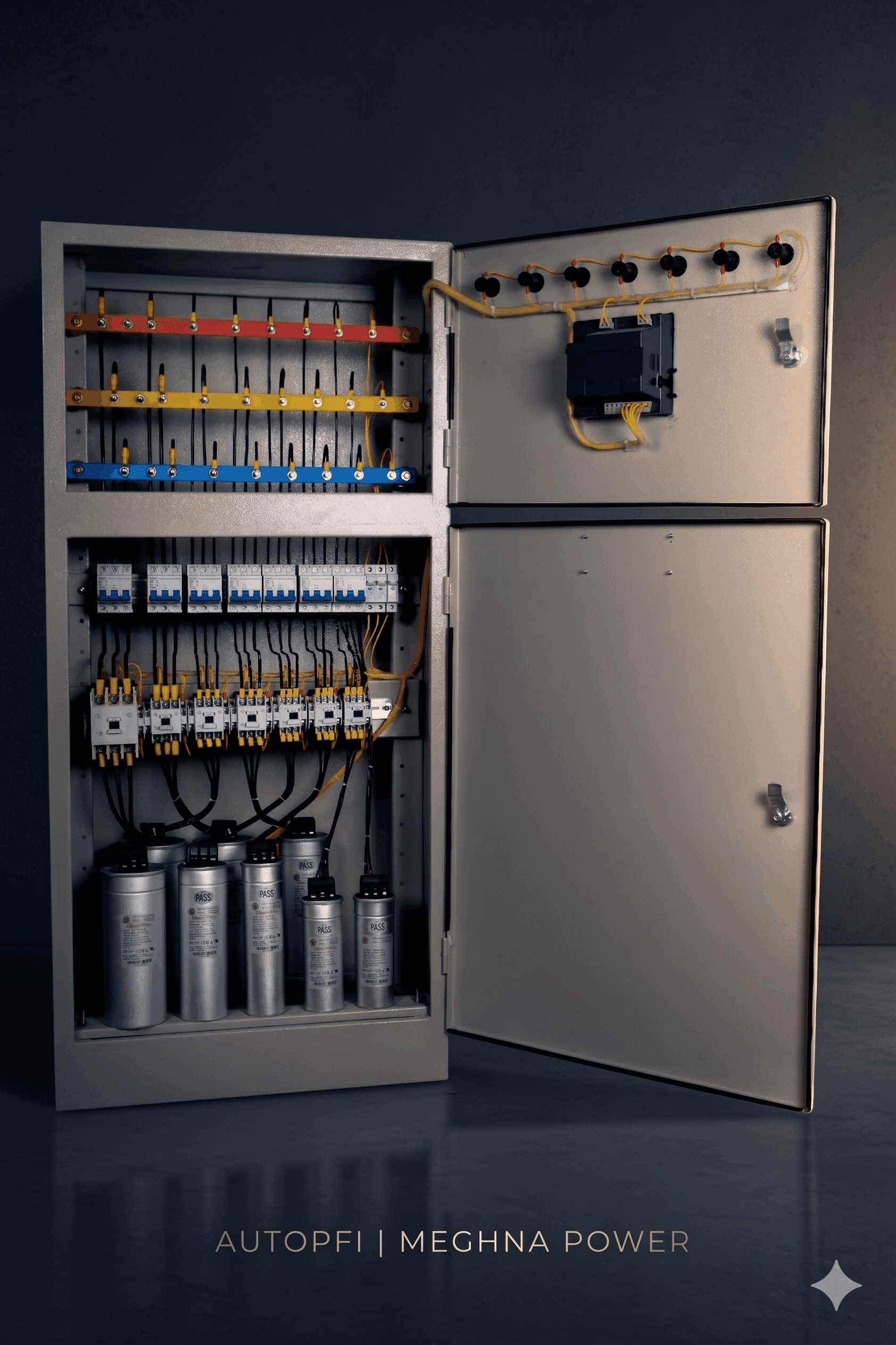
SPECIFICATIONS
APPLICATIONS
Textile & Spinning Mills
Large motor loads in weaving and spinning create significant reactive demand. PFI panels bring factory power factor within BPDB billing thresholds.
Cold Storage & Refrigeration
Compressor motors are heavy inductive loads. Automatic step switching keeps PF above 0.95 even as compressor duty cycles vary.
Garment Factories
Mixed loads across cutting, sewing, and finishing floors result in a varying power factor. Auto PFI panels handle this variation in real time.
Commercial Buildings
Shopping centres, office towers, and hotels benefit from PFI where chiller and lift motor loads pull power factor below utility requirements.
Steel & Foundry Plants
Arc furnaces and induction heating create large reactive current spikes. Fast-switching thyristor PFI panels control reactive demand effectively.
Pumping Stations
Water treatment and irrigation pump stations running multiple induction motors benefit from centralised reactive compensation.
FREQUENTLY ASKED QUESTIONS
How much can I save on my electricity bill?
Savings depend on your current power factor and utility tariff. Industries moving from a power factor of 0.75 to 0.98 typically see maximum demand charges fall by 20–30%, with additional savings from reduced I²R losses in their distribution system. We can estimate your specific savings from your last three utility bills.
What is the difference between contactor-switched and thyristor-switched panels?
Contactor switching is lower cost and suitable for most industrial loads. Thyristor (solid-state) switching is faster and transient-free, making it appropriate for loads with rapid power factor fluctuations such as arc furnaces or variable-speed drives.
Will a PFI panel cause problems with my variable frequency drives?
Standard fixed capacitor banks can interact badly with VFDs, but our auto PFI panels are designed with detuning reactors (typically 7% or 14%) when VFDs or other harmonic-generating loads are present. This prevents resonance and capacitor overload.
How long does installation take?
For a standard industrial installation, our team can complete wiring, commissioning, and power factor verification in one working day. Larger multi-panel installations may take 2–3 days. We work around your production schedule where possible.